

Six rounds in, one client, results I didn’t fully see coming. I’m writing this while the work is still going because the numbers already deserve a proper accounting.
Getting an asset manager’s website to perform in AI search doesn’t happen in one pass. I know, because we just wrapped six audit iterations on a single client engagement, and the results only landed where they did because we kept going past round two.
Here’s what the process actually looked like, including the parts most agencies skip over.
Round 1: The Audit Surfaces What You Missed
Bolden runs a structured GEO audit that goes into corners most developers don’t think to check. The first pass on this client surfaced a list that was longer than anyone expected, including our own team that had built the site.
Fund pages with untapped schema potential. Meta descriptions duplicated across twelve pages. An About Us section that read well for humans but answered nothing for AI engines. Headings that functioned as labels instead of questions.
We came out of Round 1 with 20 specific, prioritized recommendations. That number matters. It set the scope and gave us a way to track progress objectively across every subsequent pass.
Round 2: Client Feedback Sharpens the Plan
Some fixes are quick. Others open up longer conversations, especially around content.
This client had been operating for over 20 years. Their track record is the product. Part of Round 2 was helping them see that the data they had been accumulating (AUM growth, distribution history, fund performance) was a GEO asset sitting mostly untapped. AI engines don’t cite PDFs buried behind a tab. They cite prose that answers questions.
We also hit the first real constraint here. Some recommendations, like benchmarking against named competitors or making direct performance comparisons, weren’t implementable. Not because the recommendation was wrong, but because in asset management, certain comparisons on your own website can be a compliance issue. The audit flagged the opportunity. The client made an informed call not to take it.
That’s not a failure. That’s the process working correctly.
Round 3: Staging, Not Live
Everything went into staging before it touched production. Content revisions, schema additions, a new FAQ page built from scratch (the live site had a /faq/ URL returning a 404), and a structural fix that turned out to be more consequential than it first looked.
The original resources page loaded its documents behind tab clicks. Clean UX for a human. Invisible to an AI crawler, because each tab was a separate interaction, not a separate URL. We restructured it so every document category rendered on one page. That change alone opened up a substantial amount of previously uncrawlable content.
Round 3 also confirmed the staging work with a full re-audit before anything deployed. Systematic, not guesswork.
Round 4: Compliance, the Necessary Friction
Asset management compliance review is non-negotiable. It’s also where GEO optimization and legal requirements push against each other.
A disclaimer gets added. A direct claim gets qualified. A heading gets softened. Each of those edits can affect how an AI engine reads the page and reduce the clarity that makes content citable.
We have learned to navigate this tension: preserving the structure and specificity of optimized content while satisfying every compliance requirement. This round looped. Compliance came back with a second pass. We adjusted. We re-tested. We planned for it.
Round 5: Production, Then Re-Audit
When compliance signed off, we pushed to production. Then we re-audited the live site, because staging is not production, and what validates in one environment doesn’t always behave the same in the other.
This pass also had to reconcile something unexpected: three separate external evaluations of the site came in with apparently contradictory scores. A ChatGPT review graded it an A-. A separate evaluation scored it 54/100. And Otterly’s live citation data told a different story than either grade.
The 54/100 had a specific claim at its center: that two of the site’s five main pages were functionally invisible to AI crawlers. The diagnosis was a non-JavaScript crawl artifact. The raw HTML without script execution looks empty for client-rendered sections. But in-browser verification showed those pages fully rendered with complete content. More importantly, one of the allegedly invisible pages was the site’s third-most-cited URL, with 93 citations. A page that AI engines are actively quoting is not invisible to them.
The lesson: not all GEO scores measure the same thing. An academic grade on raw HTML structure and a live citation count are two different exams.
Round 6: The Numbers Come In
The Otterly Brand Report landed with data we didn’t fully predict at the start of the engagement.
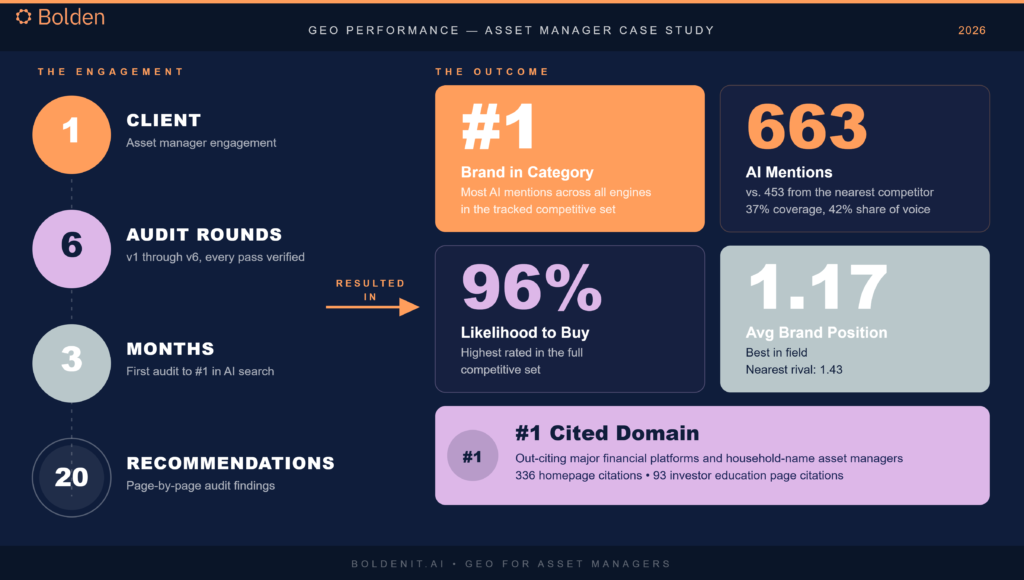
- #1 brand in category by AI mentions, with 663 vs. the nearest competitor’s 453
- #1 cited domain, out-citing major financial data platforms and household-name asset managers tracked in the same query set
- Average brand position: 1.17, best in the field (nearest competitor: 1.43)
- Likelihood to buy: 96%
- Brand coverage: 37%, share of voice: 42%
These numbers came from tracking 35 prompts across major AI engines over the prior 14 days. The homepage alone had accumulated 336 citations. The investor education page, a 13-section Q&A resource with a 25-term glossary that had been on the site for years, had 93.
That last point is worth sitting with. The content was already there. It had been there for a long time. The work wasn’t to invent something new. It was to structure what existed so AI engines could read, index, and cite it.
What Six Iterations Actually Teaches You
Eight of 20 recommendations are live on production as of this writing. The remaining 12 are either in the build pipeline or staged and ready to deploy. The score is not final.
That’s the honest reality of GEO for an asset manager. You don’t get to the top in one pass. You get there by treating it as a process: audit, implement, verify, comply, re-audit, repeat, and measuring outcomes in the metric that actually matters. Whether AI engines are citing your content when someone asks a question you should be answering.
The firms getting cited today are the ones that committed to the full journey. Not a one-time project. Not a quick win. A process.
At Bolden, we run full GEO audits for asset managers, 20+ page-by-page recommendations covering structure, schema, content, and meta. Reach out at boldenit.ai.